Many of Miami's brightest emerging scholars can be found in FIU Honors College, a hub for the talented and ambitious next generation of thought leaders. Representing the full range of our FIU's rich array of academic disciplines, Honors College students often stand out from the pack—accomplished, open to experimentation, and eager to investigate new areas of interest. When The Wolfsonian invited students to propose creative avenues into the museum's modern-age collection, unsurprisingly it was two art-curious Honors College students who enthusiastically answered the call.
Sharing a passion for poetry, senior Dean Kandi and junior Melanie Giraldo were excited about the same idea: penning ekphrastic poems about Wolfsonian collection works. Ekphrastic poems are meant to bring a picture to life, describing it in vivid detail, evocatively exploring the scene or artist's emotions, or even expressing the artwork's point of view. Other times, ekphrastic poems use the image simply as a jumping-off point, taking the concept in a very different direction. With these approaches in mind, Dean and Melanie each dove into the Wolfsonian holdings to select an object as muse, and—after receiving expert guidance by Caridad Moro, an award-winning poet and seasoned leader of ekphrastic poetry workshops—began writing.
Their poems, as well as the works that sparked inspiration, are presented below in honor of Poetry Month.
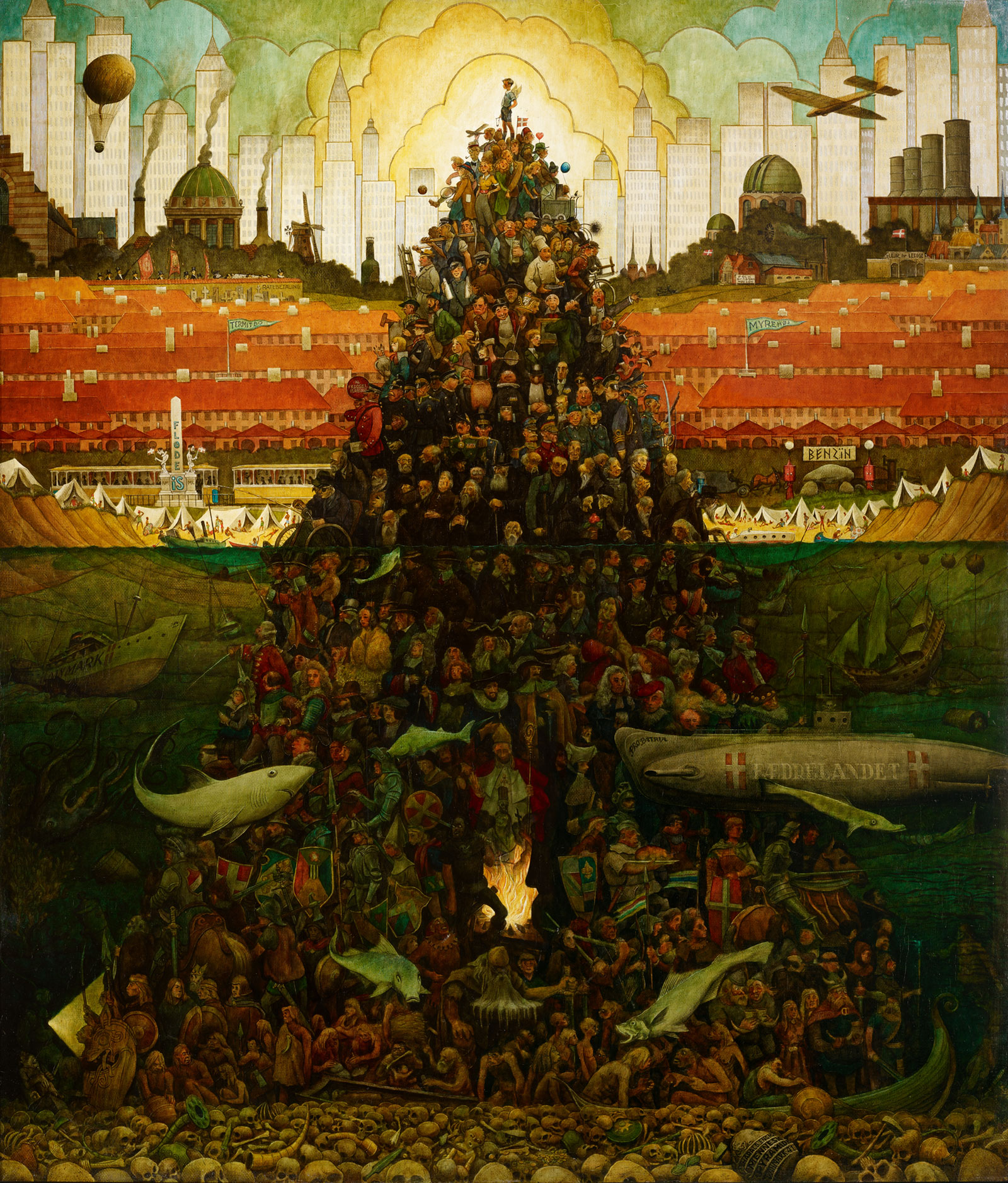
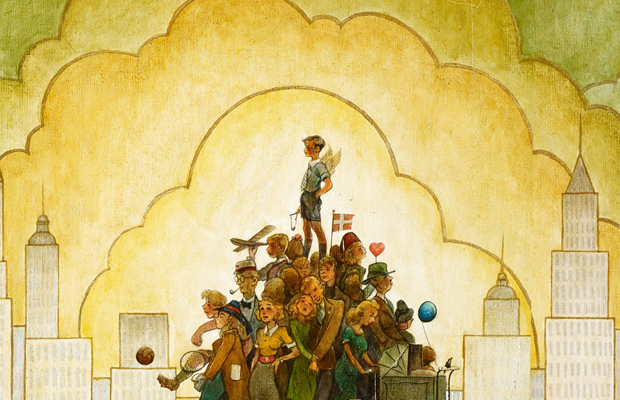
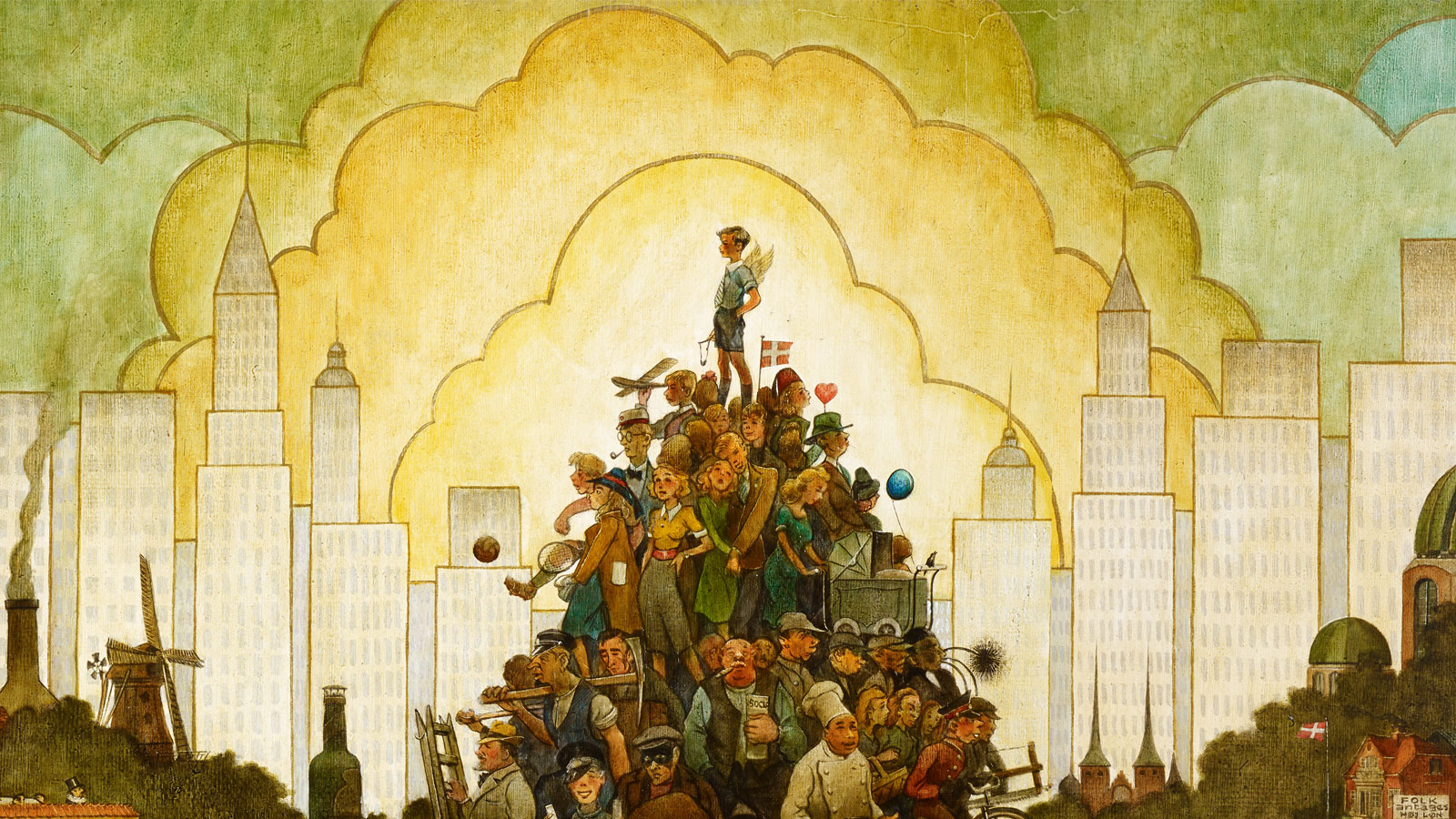
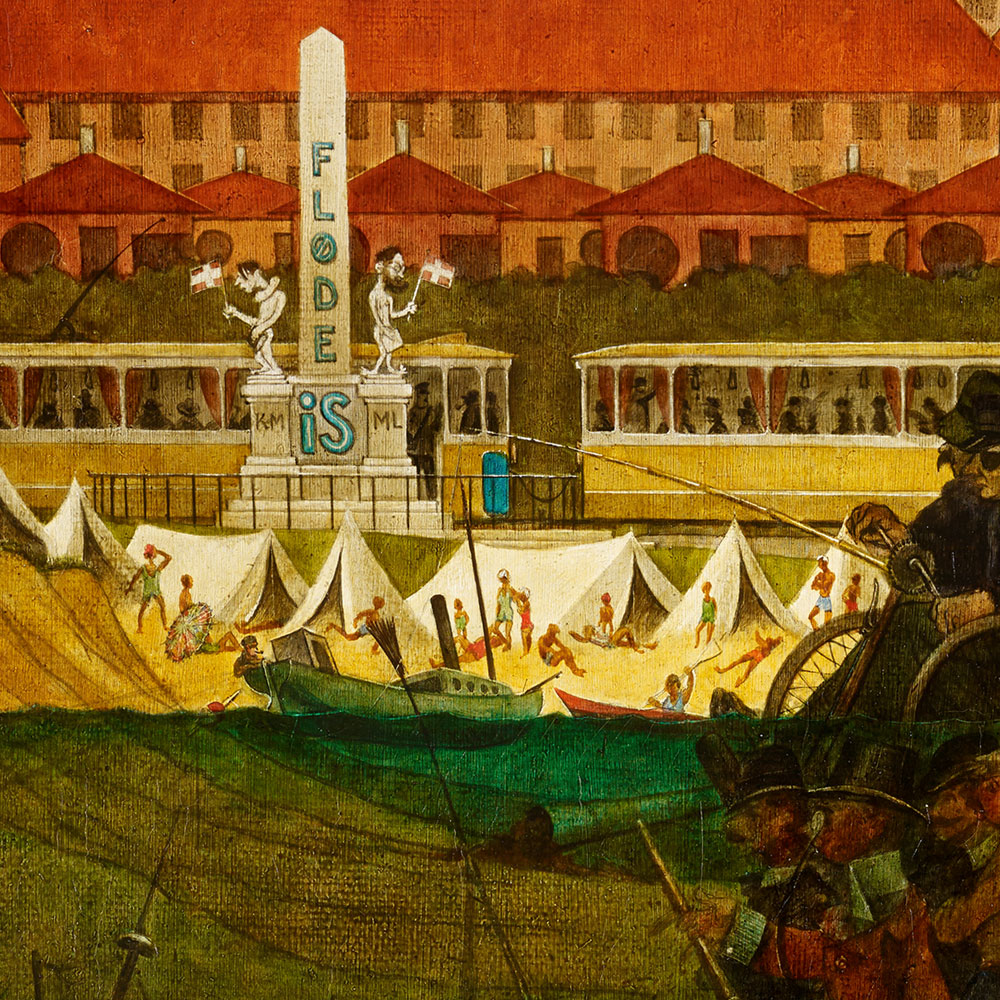
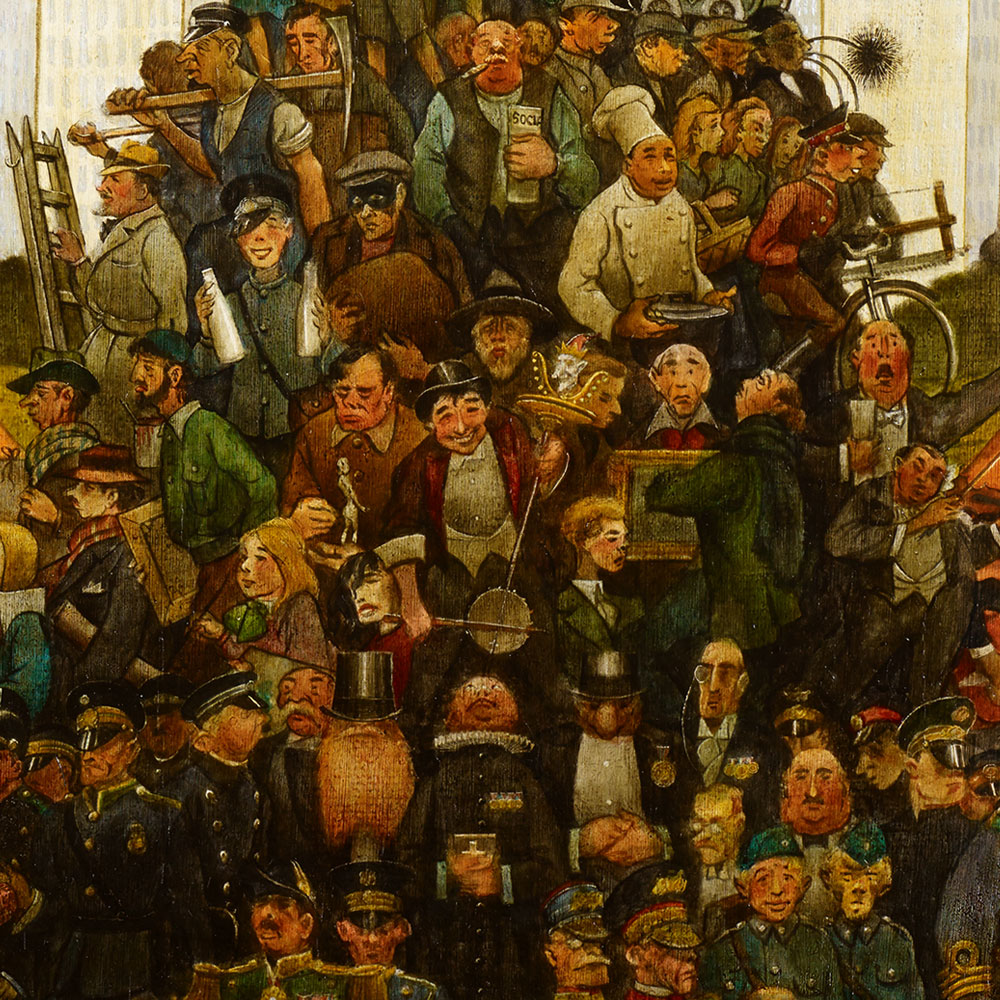
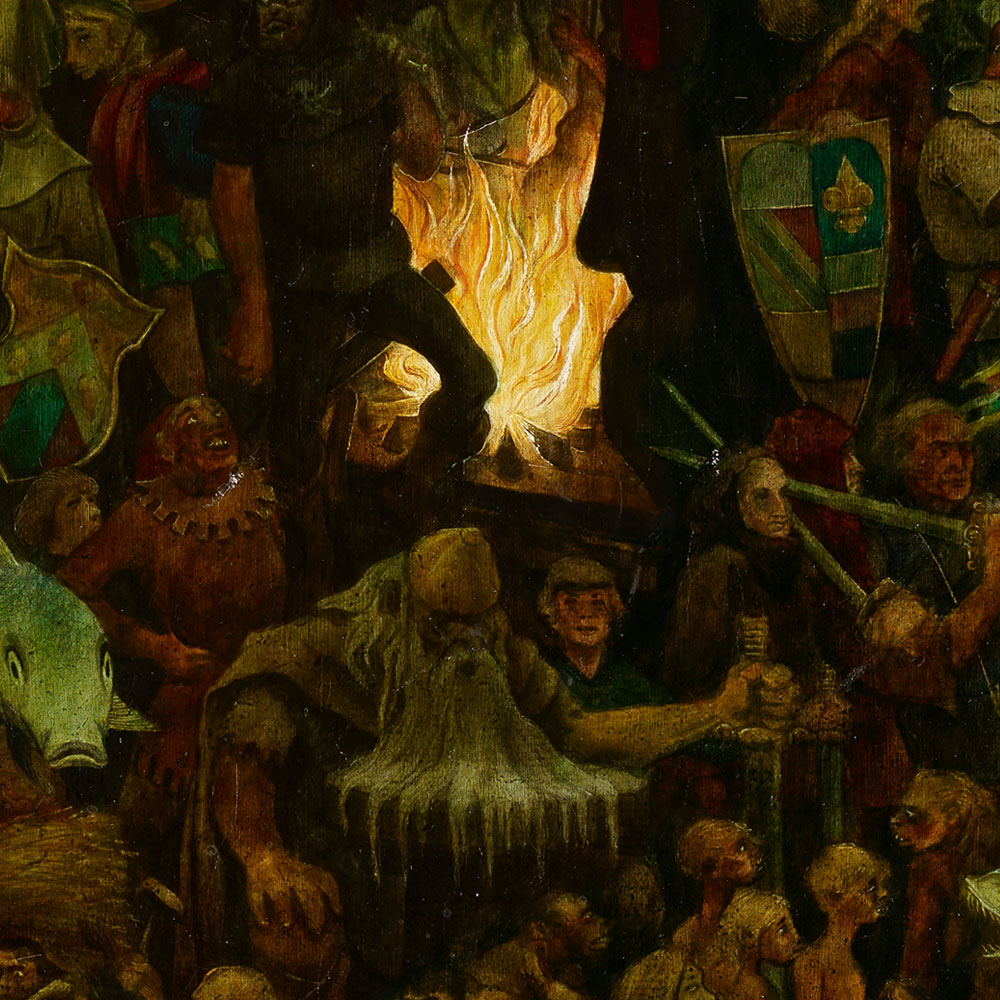
Painting, Menneske Pyramide [Human Pyramid], 1941. Harald Engman, artist. The Wolfsonian–FIU, The Mitchell Wolfson, Jr. Collection, 87.789.5.1.
Harald Engman illustrates history as a pyramid of characters that terminates with the figure of a cherubic, contemporary David with slingshot in hand standing in defiance of a modern-day Goliath—the German forces occupying Denmark. "Faedrelandet," inscribed on the submarine, refers to the newspaper of the Danish National Socialist Workers' Party, Denmark's version of the Nazi party.
As the water rises
waves bring in
wars that bear more
than the blood of man
and the acquisition of land
wars that strike
the depths of who we are
stripping away at the surface
like sandpaper to the grain
again, and again
we fight
we hold our swords up
the west charges towards the east
the east towards the west
but a world of black and white only
exists through the eyes of one
peeking through the greyscale
this earth spins
weaving colors
that don't exist
trying so desperately
to knit the soul of mankind
together
still her needles sow faith
in the soldier on his knees
he too will dream when he lies his head
for the days of insatiable hierarchies and
misogyny
to bear its end
as the viking is served his golden plate
at the table of kings
they tell the peasant
to eat from the bottom of the sea
but the table was crafted by man
and the ground connects man back to earth
the crafting of God
on his knees again
the soldier dreams
one day
he will put the swords down
– Dean Kandi, senior (Political Science major)
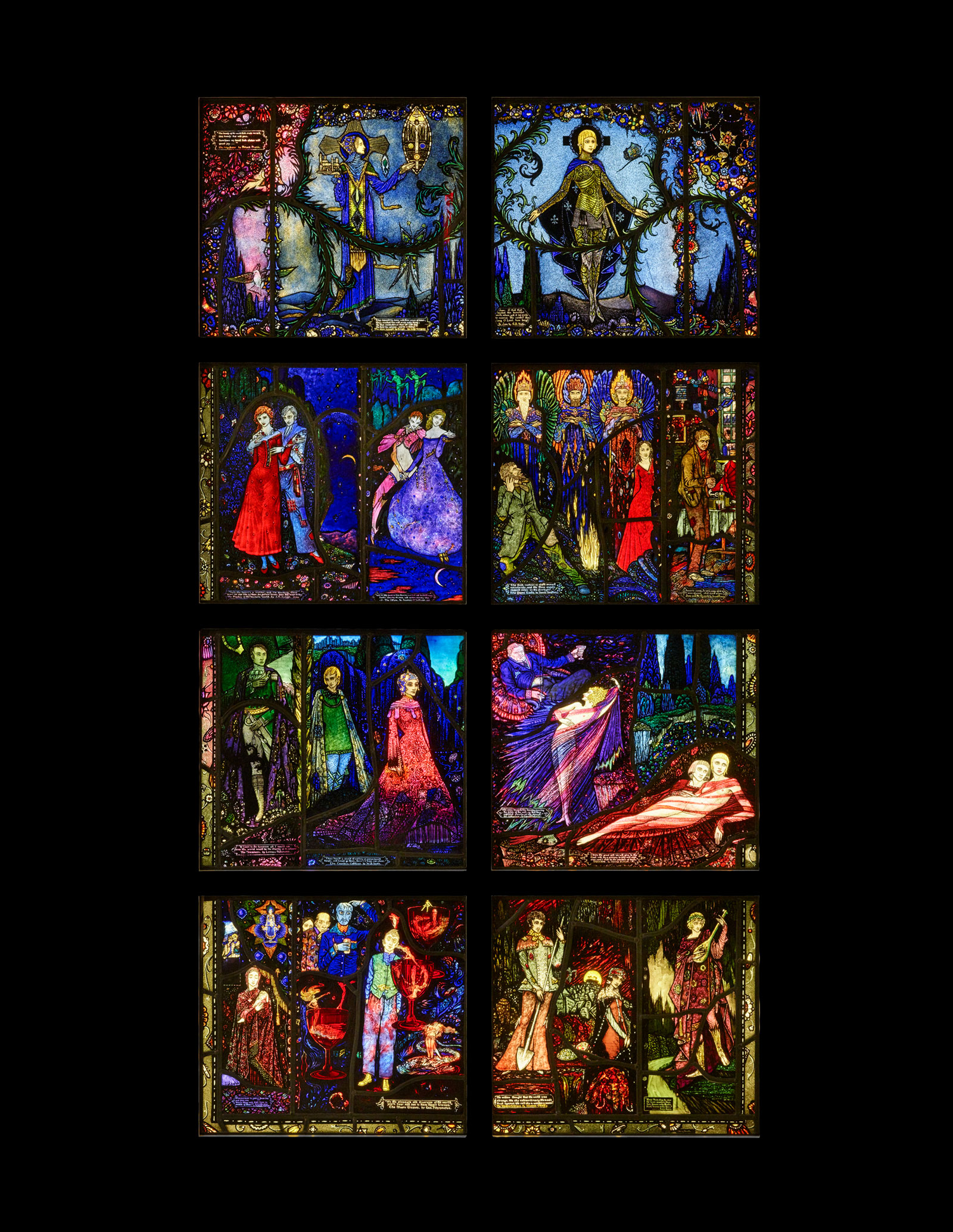
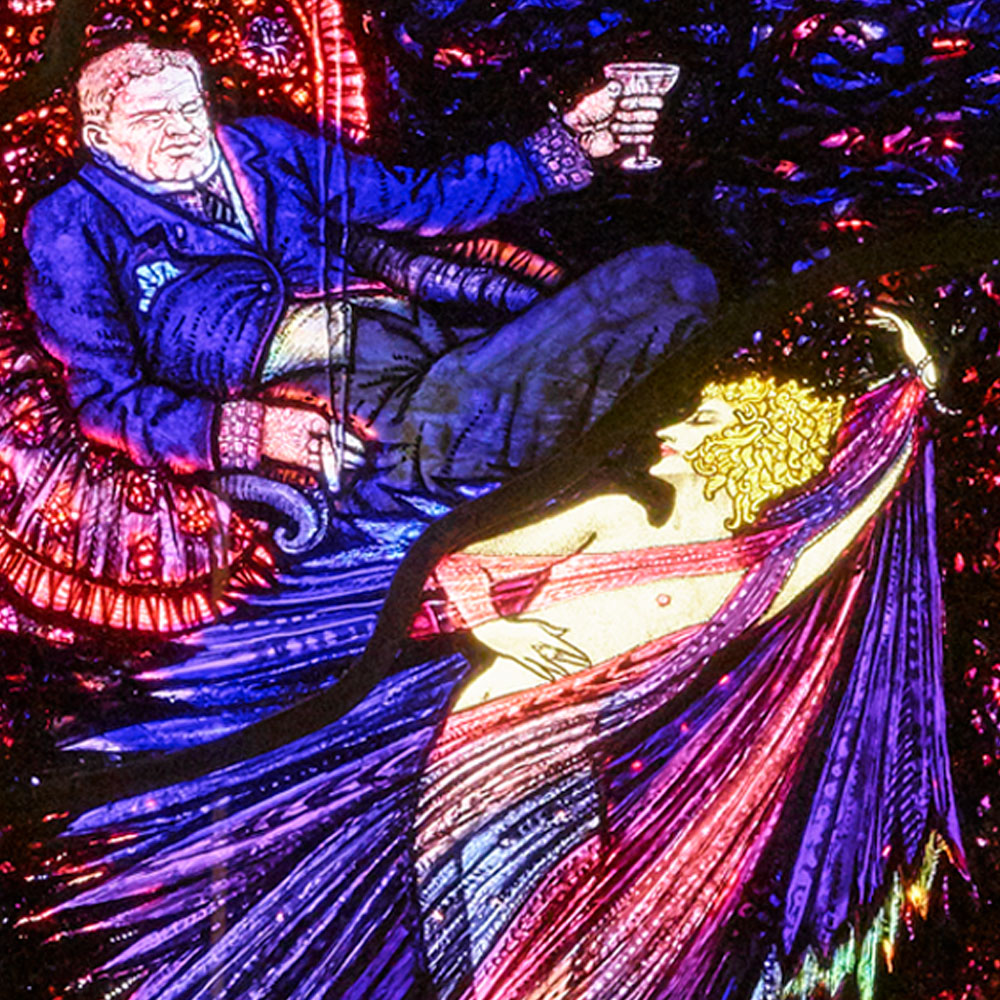
Stained-glass window, commissioned 1926, completed 1930 (never installed). Harry Clarke, designer. The Wolfsonian–FIU, The Mitchell Wolfson, Jr. Collection, TD1988.34.1.
The Irish Free State, precursor to the modern Republic of Ireland, commissioned Harry Clarke to produce a stained-glass window for a League of Nations building in Geneva. Charged with celebrating Ireland's literary prowess, Clarke chose to illustrate passages from works by George Bernard Shaw, James Joyce, W. B. Yeats, Lady Gregory, and others. Though he avoided some controversial texts—omitting, for example, Joyce's Ulysses as it was either banned or restricted throughout the English-speaking world—the completed panels included scenes of nudity, sex, madness, and other topics deemed inappropriate by the Irish government. An artistic testament to Ireland's outsized contribution to English literature, the window is also an artifact of state censorship.
Ireland in the eyes of Clarke, snippets of life inspired by words and books and brogue
Illustrations of vices taking more importance than family, questioning the strength of one's faith
Naked bodies indulging in each other's presence, mirroring almost all 7 deadly sins
On a rosy day, sun rays hit the window's every crevice
Each reflection lighting up moral flaws of gluttony, greed, lust, and pride
Anecdotes of the human experience wallowing in sex, booze, and luxury
Each vignette leaning toward apostasy as the images are lit
The reality of life is too honest to be received by Ireland's free state
Consternation is expressed as rejection as the decorative art no longer suits their wants
Fearful of their personal portraits in the window
The willingness to accept an honest attestation of the country
Quickly fades as a truthful embodiment of life is materialized
– Melanie Giraldo, junior (Chemistry major)